
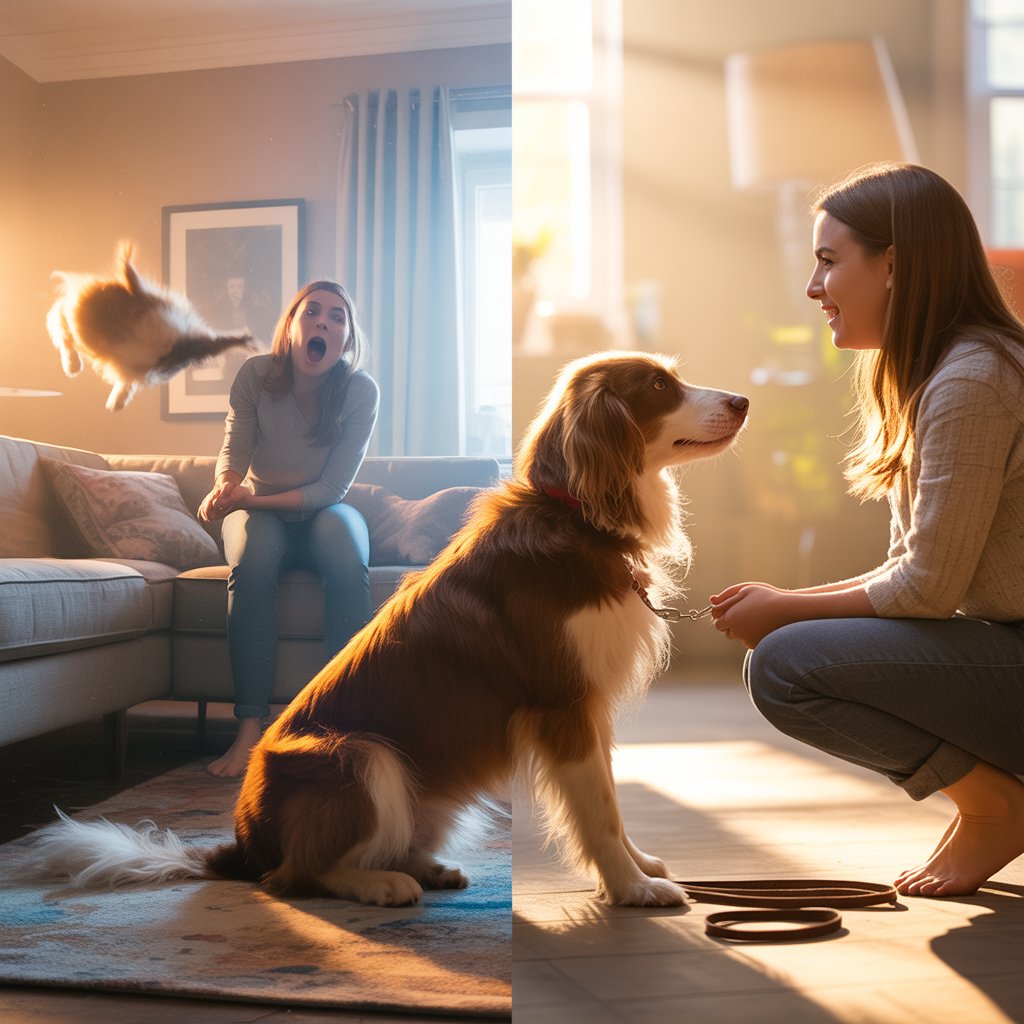
There’s a moment every new dog owner experiences.
It usually happens after the fifth time you’ve said “sit,” when your dog stares at you like you’re speaking another language… then launches themselves at the couch, the door, or your unsuspecting guest.
You love them. Of course you do.
But love and obedience are not the same thing.
If you’ve been searching for a free dog training course for beginners at home, not because you want tricks—but because you want peace—this is your starting line.
No previous experience.
No expensive classes.
No shame.
Just structure, clarity, and a dog who begins to understand you.
What a Free Dog Training Course for Beginners at Home Really Means
Strip away the noise and dog training is simple communication.
A true free dog training course for beginners at home isn’t a random collection of tips. It’s a structured progression that teaches:
- Focus
- Clear commands
- Reliable obedience
- Calm behavior in real environments
And it does it using one powerful principle: positive reinforcement.
Not dominance.
Not intimidation.
Not complicated psychology.
Just cue, action, reward—repeated with consistency.
This guide is built specifically for:
- First-time puppy owners
- Rescue adopters navigating unknown behavior
- Busy people juggling work and family
- Apartment dwellers with limited space
- Anyone quietly wondering, “Am I doing this wrong?”
You’re not doing it wrong.
You just need a roadmap.
Before Training Starts: The Three Rules That Change Everything
Most beginners jump straight into commands.
That’s where friction begins.
Training works when three invisible forces are aligned: timing, consistency, and emotional state.
Miss one, and progress feels random.
Master them, and everything accelerates.
1. Dogs Learn Through Patterns, Not Lectures
Every behavior follows a loop:
Cue → Behavior → Consequence
If the consequence feels good, the behavior strengthens.
That’s the entire foundation of positive reinforcement dog training.
Rewards can be:
- Soft, pea-sized treats
- A warm “Yes!” spoken with certainty
- Play
- Touch
The reward doesn’t have to be extravagant. It has to be immediate.
2. Timing Is Precision
Imagine someone clapping five seconds after you finish a performance. It feels disconnected.
Dogs feel that same confusion when rewards come too late.
Mark the exact moment your dog does the correct behavior.
Then reward.
That timing—often within one second—is the difference between clarity and chaos.
3. Consistency Outperforms Motivation
You don’t need long sessions.
You don’t need loud enthusiasm.
You need 5–10 focused minutes daily.
Small repetitions beat occasional intensity every time. Training isn’t a motivational burst—it’s rhythm.
Your 8-Week Free Dog Training Course for Beginners at Home
This is where structure replaces stress.
Think of this as a staircase. Each step builds stability for the next.
Weeks 1–2: Build Attention Before Commands
Before “sit.” Before “stay.” Before anything else.
You teach focus.
Say your dog’s name once.
The instant they look at you—“Yes!”—reward.
Repeat it calmly. Not twenty times. Just ten clean repetitions.
When your dog snaps their head toward you at the sound of their name, you’ve unlocked attention.
And without attention, obedience never sticks.
Weeks 3–4: The Core Commands (Sit, Down, Stay)
Now the language begins.
Teaching “Sit”
Lift a treat slowly above the nose.
As the head follows, the body lowers.
The moment the tail touches the floor—mark and reward.
Keep it light. Keep it brief. Five to ten repetitions per session.
Teaching “Down”
From a sit, lower the treat straight toward the floor.
When elbows touch ground—mark and reward.
Down builds impulse control. That’s why it feels powerful.
Teaching “Stay”
Ask for a sit.
Open your palm. Say “Stay.”
Take one step back. Pause. Return. Reward.
Expand distance gradually.
When beginners rush this phase, frustration creeps in.
When they slow down, confidence grows.
Weeks 5–6: Leash Manners Without Battle
Pulling on the leash doesn’t mean your dog is stubborn.
It means forward movement is rewarding.
So you change the rule:
The leash only moves when it’s loose.
Dog pulls?
You stop.
Dog relaxes tension?
You move again.
No yelling.
No jerking.
Just consistent consequence.
Within days, patterns begin shifting.
Weeks 7–8: Recall—The Command That Protects Life
If you teach only one advanced skill, teach this.
Start indoors.
Say your dog’s name.
Take a few excited steps backward.
When they come—celebrate and reward generously.
Coming when called must always feel safe.
Never punish after recall.
Never scold after success.
Build distractions gradually: another room, the yard, a quiet park.
Recall turns anxiety into confidence.
When Things Don’t Go Smoothly (Because Sometimes They Won’t)
Even the best free dog training course for beginners at home meets resistance.
Not because your dog is flawed.
Because learning is layered.
“Why does my dog ignore me?”
Usually:
- Distractions are too high
- Rewards aren’t valuable enough
- The command has been repeated too often
Lower the environment difficulty. Increase reward value. Say it once.
“Why does training collapse outside?”
Dogs don’t generalize automatically.
A behavior learned in the living room does not equal mastery at the park.
Progress environments slowly:
- Living room
- Different room
- Yard
- Quiet street
- Busy space
Layer complexity like weight on a barbell—incrementally.
The 10-Minute Training Rhythm for Busy Owners
You don’t need an open afternoon.
You need intention.
Morning (3 minutes):
• Name recognition
• Five sits
Midday (2 minutes):
• Down practice
• Two brief stays
Evening (5 minutes):
• Leash reps
• Three recall practices
That’s it.
Short sessions prevent burnout and keep engagement sharp.
The Questions You’re Probably Asking Quietly
“How long before I see real results?”
With consistency, noticeable improvement appears within two weeks. Solid foundational obedience typically stabilizes within six to eight weeks.
“Can I really train my dog at home without a professional?”
Yes—basic obedience thrives in home environments because consistency is easier to maintain. Professional support becomes helpful when aggression or severe anxiety is present.
“What’s the easiest command to start with?”
Sit. It aligns naturally with a dog’s movement and builds early confidence for both of you.
“How many sessions per day are ideal?”
Two to three short sessions outperform one long, exhausting attempt.
What Training Actually Changes (Beyond Behavior)
Something subtle happens around week three.
Your dog begins looking to you for cues instead of scanning the room.
Walks feel quieter. Guests feel less stressful. Your tone softens.
Training isn’t domination—it’s partnership.
You move from reacting…
to guiding.
And when that shift happens, obedience isn’t the reward.
Connection is.
Products / Tools / Resources
If you’re building your at-home system, these essentials make the process smoother:
High-Value Soft Training Treats
Small, low-calorie rewards that can be delivered quickly without breaking focus.
Standard 1.5–2 Meter Leash
Avoid retractable leashes during foundational loose-leash training.
Front-Clip Harness
Provides additional control during early outdoor sessions without harsh correction.
Clicker (Optional but Effective)
For beginners who want cleaner timing markers beyond verbal praise.
Interactive Puzzle Toys
Support mental stimulation on non-training days and reduce boredom-driven behavior issues.
Structured Training Journal or Printable Tracker
Recording sessions helps you notice patterns, progression, and where adjustments are needed.
You don’t need perfection.
You don’t need advanced credentials.
You need repetition, patience, and the willingness to show up for ten minutes a day.
And once you do, your dog won’t just listen.
They’ll look at you differently. Get your free training here.








0 Comments